Up to 40% OFF + Get an extra 12% OFF. Use Code: DHAMAL12 | Shop Now !


September 26, 2026 0 Comments
Quitting tobacco starts with willpower. The rest is what happens after, the five-minute breaks, the gap tobacco used to fill, and the small routines that quietly take its place.
Tobacco use rarely stays random for long. It attaches itself to specific moments: after a meal, during a stressful call, the walk to the parking lot, until those moments start feeling incomplete without it.
That's the trigger and routine part. The third piece is the dependency cycle itself, where your brain starts expecting a hit of dopamine at predictable points in the day. Skip it, and the body notices, sometimes before you've consciously registered the craving at all.
Walking works better than people expect it to. It's not just a distraction; it's giving your body something to actually do with the restless energy a craving brings.

Nicosure nicotine gum/lozenge works well here, it supports that same hand-to-mouth motion while also managing the nicotine side of the craving directly, so you're not relying on willpower to fight the chemical pull and the habitual one at the same time.
Mindfulness exercises help with the mental side. Just naming what's happening, "this is a craving, it'll pass," does more than people assume.
Journaling works for some people better than anything else on this list. Writing down what triggered the craving, even just one line, builds awareness over time that you can't get any other way.
Creating new routines matters more than picking the "right" replacement habit. If tobacco was tied to your morning coffee, change something about that routine, not just the tobacco part of it. Drink your coffee somewhere different. Have it standing instead of sitting, or move from the balcony to your desk. The goal is to break the specific physical pattern your brain has linked to tobacco, so the coffee stops automatically cueing the craving in the first place.
Reward progress along the way. Not in a forced, gold-star kind of way, just acknowledge it. A week without tobacco is worth noticing.
Track your triggers too. Write down when cravings hit hardest. Patterns show up faster than you'd think, and once you see them coming you can plan for them.
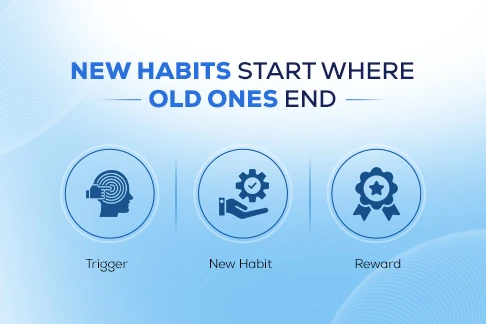
Most people trying to figure out how to break bad habits and addictions start in the wrong place. They focus on the craving itself, white knuckling through it, instead of looking at the loop that's producing it in the first place. The trigger, the craving, the action, the relief. Skip straight to fighting the craving and you're fighting the strongest part of the cycle, the part specifically designed to win.
Start with the trigger instead. Say it's always the drive home from work. That's not random, that's your brain pairing a specific stretch of road with a specific reward, built over hundreds of repetitions. You can't unlearn that overnight, but you can notice it happening, which is the part most people skip entirely. Naming it, "this is the drive-home trigger, here it comes," takes some of its power away just by making it visible instead of automatic.
From there, behavioral strategies actually do something. Delaying the response by five minutes, just five, breaks the assumption that the craving demands an immediate answer. A lot of cravings peak and start fading within that window on their own. Swapping the action without skipping the routine helps too, keep the drive home, keep the same time of day, just change what your hands do during it. Chew something. Call someone. Put on a specific podcast you only listen to during that drive, so the brain starts building a new association instead of falling back on the old one.
And this is where support systems stop being optional. Not in a vague, "lean on your loved ones" way, but specifically, having one person you can text the moment a craving hits hardest, before you've acted on it, not after. Some people make this literal, a single contact saved as "call before you smoke." It sounds almost too simple. It works because it forces a pause between the urge and the action, and that pause is usually all that's needed.
Exercise shows up on every list like this for a reason that's measurable, not just motivation. Regular movement lowers your baseline stress hormones over weeks, not just in the twenty minutes you're exercising. That matters because a lot of tobacco use was never really about tobacco, it was about managing stress, and exercise quietly takes over that job if you give it enough time.
Sleep gets underestimated constantly, and it shouldn't be. A bad night's sleep doesn't just make you tired; it directly weakens the part of your brain responsible for resisting impulses the next day. Studies on this are consistent, people are sleep-deprived report stronger cravings and have a harder time saying no to them. So, protecting sleep during a quit attempt isn't a nice-to-have, it's closer to a requirement. Stress management is really the long game underneath everything else on this list.
There's no single substitute that replaces tobacco cleanly. It's not a one-for-one swap. What works is a handful of smaller habits running at the same time, a walk after lunch, water kept within reach, five slow breaths during the worst of a craving, NRT like Nicosure when the craving won't let up, one person you trust enough to call when it gets hard. None of them are individually powerful enough to do this alone. Together, over a few months, they start filling the space tobacco used to occupy, until one day you notice the gap just isn't there the way it used to be.
Curious if NRT could help smooth out the hardest part of quitting? Nicosure is worth a look.




Your cart is empty
Browse Products
(200 pieces)

(60 pieces)

(160 pieces)